Vuqelari
Flow Layout
Flow Layout
Couldn't load pickup availability
- Problem Statement
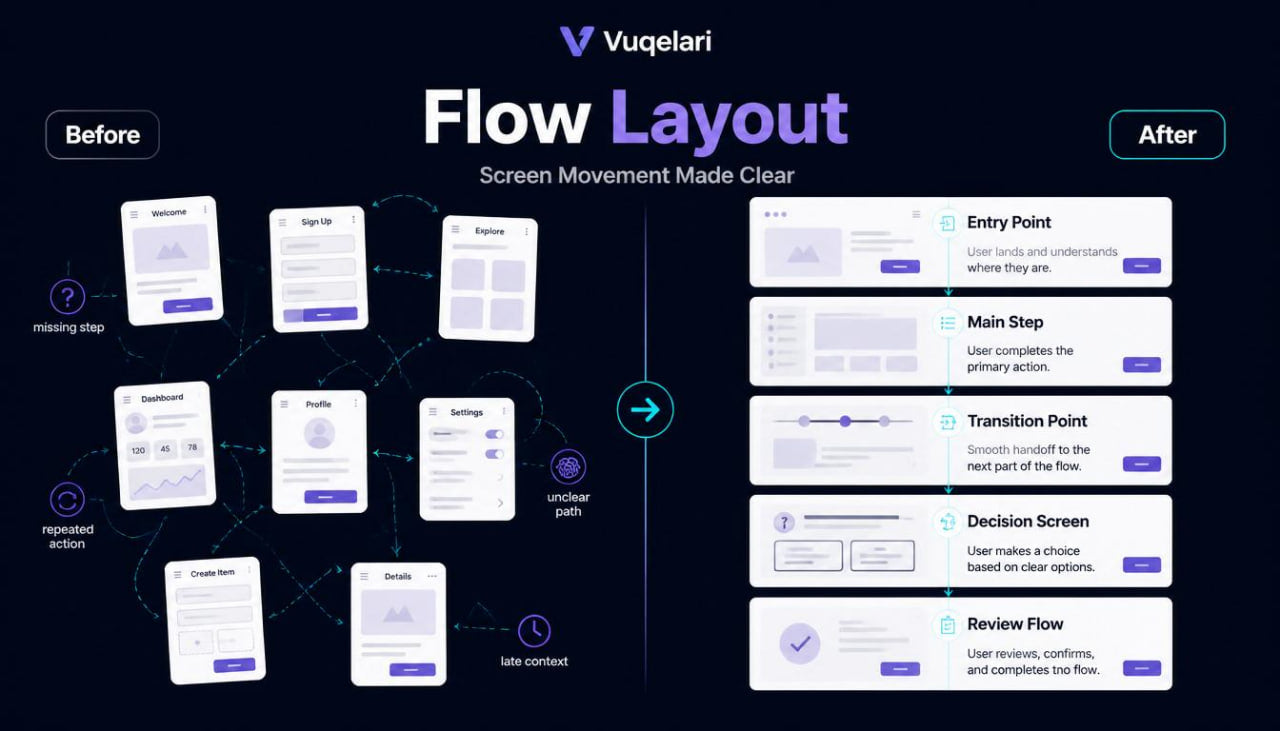
Many learners can plan a single screen, but they may struggle when several screens need to work together. A layout may look organized on its own, yet the user path can still feel unclear when the next step is hidden, repeated, or placed in the wrong area. Learners may also find it difficult to decide how much information belongs on one screen and when a topic should move to another step. Without a flow-based study method, screens can feel like separate pages instead of parts of one journey. Flow Layout was created to help learners study UI/UX design through movement, screen order, and practical path planning.
- Solution
Flow Layout teaches UI/UX design through the connection between layout and user movement. The course explains how to plan a page sequence, define what each screen should do, arrange sections around the user path, and review whether the next step feels natural. The materials use written modules, diagrams, examples, checklists, and practical tasks to make flow planning easier to study. Learners work with screen outlines, simple journey maps, content grouping, and action placement. This tier gives a wider method for studying UI/UX design as a connected experience rather than a set of separate screens.
- What’s Inside
Flow Layout includes a detailed collection of UI/UX design materials built around user flow, layout sequence, and connected screen planning. The first module introduces flow thinking. It explains that a user journey is made from steps: entry, reading, choosing, entering details, reviewing, confirming, or moving onward. Learners study how each step should have a role and how the layout should support that role. The course explains that flow is not only about drawing arrows between screens. It is about understanding what the user needs at each stage and how the interface can guide that movement.
The second module focuses on screen sequence. Learners study how to arrange several screens in a logical order. This section explains how one screen can prepare the user for the next screen, how a form can follow an information section, and how a review page can appear after a choice has been made. The materials include simple sequence examples with three to five screens. Each example shows how the page purpose changes from one step to another.
The next module explores page load. This section explains how much information should be placed on one screen and when a topic may need to be divided. Learners study examples where too many details appear in one place, making the page feel crowded. They also study examples where information is separated too much, making the journey feel longer than needed. The goal is to help learners think about balance: enough information to support the current step, but not so much that the screen loses direction.
Flow Layout also includes a module about transition points. These are moments where the user moves from one screen, section, or action to another. Learners study how transition points can be created with buttons, links, form completion, selection areas, progress notes, or summary blocks. The materials explain how a transition point should appear where the user has enough context to make the next move. This helps learners avoid placing actions too early or too late in the page.
A separate module focuses on decision screens. Learners study layouts where the user needs to compare options, select a path, or choose between several actions. The course explains how grouping, labels, short descriptions, and visual order can support a cleaner decision process. Learners review examples of cards, rows, lists, and grouped choices. The module also explains how too many similar actions can make the screen harder to understand.
The course includes a module about forms and input flow. Learners study how forms can be arranged by topic, how labels should connect with fields, and how support notes can reduce confusion. The materials explain why form sections should follow a natural order, such as basic details before extra details, or required information before optional notes. Learners also study how a final action area can close the form in a way that matches the page path.
Flow Layout includes practical exercises that build from small tasks to wider planning activities. One task asks learners to outline a three-screen journey from introduction to action. Another task asks them to review a crowded page and decide which information should stay, move, or be grouped. A third task asks them to create a simple form flow with section labels, field groups, support notes, and a final action area.
The tier also includes a flow review checklist. This checklist helps learners ask practical questions: What is the first step? What does the user need to know here? What action belongs on this screen? What happens after the action? Is any information repeated? Is the user asked to choose before enough context is provided? Does each screen support the next one?
A second checklist focuses on layout path. It asks whether the page has a visible reading order, whether sections are grouped by purpose, whether actions appear at useful moments, and whether the visual structure supports the user journey. A third checklist focuses on forms, helping learners review field order, label placement, section grouping, and closing actions.
A glossary section is included with terms such as user flow, screen sequence, transition point, decision screen, input flow, journey map, page load, form group, next action, and review screen. Each term is explained with practical UI/UX context so learners can connect vocabulary with design tasks.
The recap section brings the tier together by showing how flow, layout, content, and action placement can be studied as one connected system. Learners finish the course with a stronger method for reviewing not only what appears on a screen, but also how each screen supports the next step.
- Who Is This For?
Flow Layout is for learners who want to study UI/UX design beyond single-screen planning. It is suitable for people who already understand basic layout structure and want to explore how screens connect into a user journey.
This tier may fit learners who ask questions such as: What should happen after this page? Where should the next action appear? How much information should stay on one screen? Should this form be divided into sections? How can a choice screen feel more organized? The course gives learners a practical way to explore these questions through modules, examples, and exercises.
Flow Layout is also suitable for learners who prefer self-paced study. The materials do not depend on named programs, operating systems, or third-party platforms. The course stays focused on UI/UX design thinking, screen order, user movement, and layout planning.
- What You’ll Learn
- How to study UI/UX design through connected user steps
- How to define the role of each screen in a journey
- How to arrange screens in a logical sequence
- How one page can prepare the user for the next page
- How to decide whether content should stay together or move into another step
- How page load affects reading and movement
- How to place transition points in useful areas
- How buttons, links, and selection areas guide the next step
- How to plan decision screens with grouped choices
- How labels and short descriptions support comparison
- How to arrange forms by topic and user order
- How support notes can help explain input fields
- How to create a three-screen journey outline
- How to review flow issues in a page sequence
- How to use checklists for layout path review
- How to connect screen purpose, content order, and user movement
- 30-Day Refund Note
Vuqelari includes a 30-day refund window for orders that match the store policy conditions. Learners should review the course materials during this period and contact the support team if the tier does not match their study needs. Refund requests are handled through the store’s regular support process and may depend on order details, delivery status, and the policy information shown on the store page.
Self-paced learning overview
- 🗂️ Digital file available after purchase
- 📚 Long-term availability
- 🔒 Secure checkout
- 🗓️ Content updated in 2026
What format are the Vuqelari course materials provided in?
What format are the Vuqelari course materials provided in?
The Vuqelari course materials are prepared as digital learning resources for self-paced study. They include written modules, visual examples, practice tasks, checklists, and review sections.
Who are the courses made for?
Who are the courses made for?
The courses are made for learners who want to study UI/UX design through organized materials and practical exercises. Each tier has its own depth, from an introductory starting point to wider topic collections.
How do I study after placing an order?
How do I study after placing an order?
After placing an order, you receive the course materials through the store’s normal delivery process. You can study the modules at your own rhythm, return to earlier sections, and use the tasks for review.
Share