Vuqelari
Halo Collection
Halo Collection
Couldn't load pickup availability
- Problem Statement
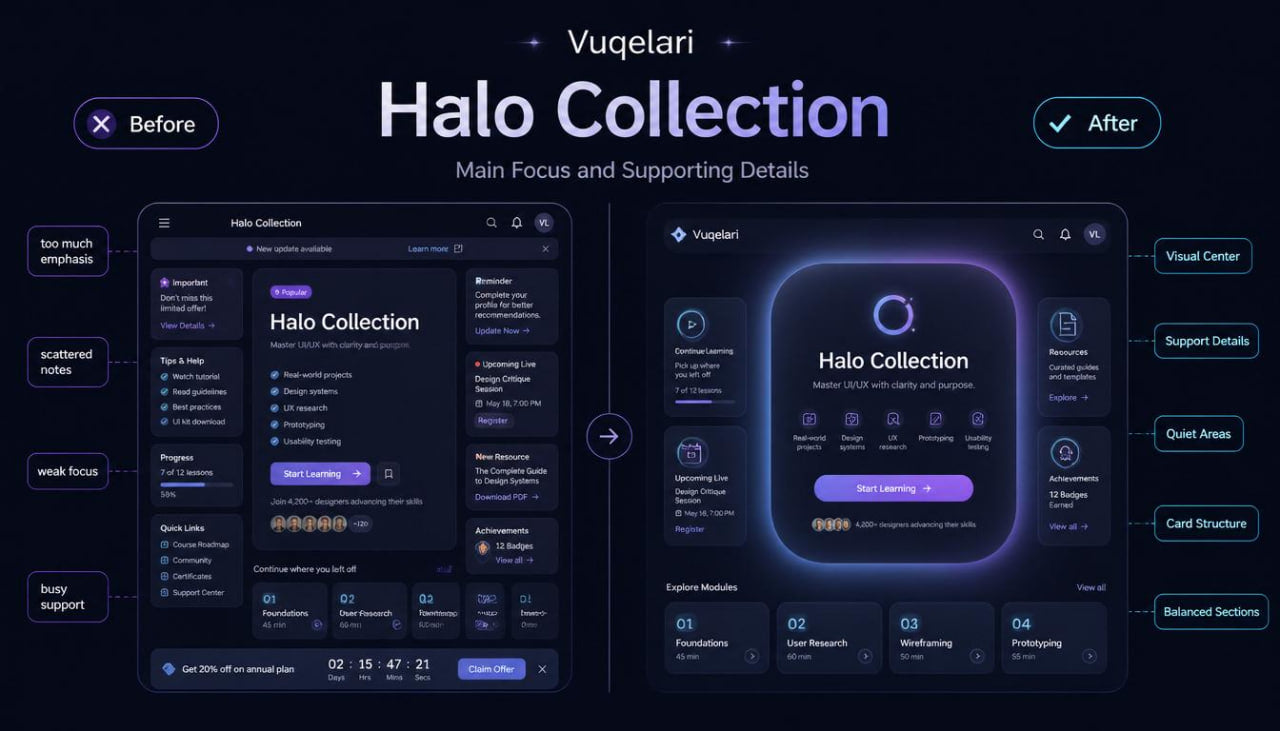
Many learners can place content on a screen, but they may struggle to make the full layout feel connected. A page can contain headings, cards, text blocks, forms, and actions, yet the relationship between those elements may still feel weak. When supporting details are not arranged well, they can distract from the main message instead of helping the user understand the page. Learners may also find it difficult to decide which parts should be visually stronger and which parts should stay quieter. Halo Collection was created to help learners study the surrounding structure of an interface: the sections, spacing, notes, and supporting patterns that shape the full screen experience.
- Solution
Halo Collection teaches UI/UX design through the idea of surrounding support. The course explains how main sections, secondary details, action zones, notes, and visual groupings work together inside a layout. Learners study how to guide attention without crowding the page, how to place supporting information where it belongs, and how to review whether a screen feels balanced. The materials use written modules, visual examples, practical tasks, and checklists for self-paced study. This tier gives learners a broader way to examine not only the central part of a screen, but also the details around it.
- What’s Inside
Halo Collection includes a detailed set of UI/UX design materials built around visual order, supporting structure, and screen clarity. The first module introduces the idea of a main visual center. Learners study how a screen often has one central purpose: explain an idea, collect information, guide a choice, or move the user toward a next step. This module shows how the surrounding layout should support that central purpose rather than compete with it. The materials explain how a heading, short explanation, grouped content, and main action can work together as the core of a screen.
The second module focuses on supporting details. Learners study how notes, helper text, secondary links, small descriptions, labels, and extra sections can be placed in a way that adds meaning without making the screen feel crowded. This section explains the difference between information that belongs in the main path and information that should stay in a quieter position. Learners review examples where support text appears near the content it explains, and examples where support text is placed too far away or repeats what the main section already says.
The next module explores visual emphasis. Learners study how size, spacing, weight, contrast, and position can make certain elements more noticeable. The course explains that emphasis should be used carefully. If every part of the page tries to stand out, the screen can lose direction. If nothing stands out, the user may not know where to begin. Learners work through examples where headings, action areas, and grouped cards are given different levels of visual strength.
Halo Collection also includes a module about quiet areas in design. This section explains why not every part of a screen needs to be visually loud. Empty space, calm support text, smaller labels, and simple separators can help the main content breathe. Learners study how quiet areas can separate topics, give the eye a pause, and make the screen feel more organized. The materials show how spacing can act as a design tool rather than an empty gap.
A separate module focuses on card-based structures. Learners study how cards can group related content, show repeated items, compare options, or present short pieces of information. This section explains how card headings, short descriptions, small labels, and actions can be arranged inside a repeated pattern. Learners review examples where cards are balanced and examples where cards contain too many competing details.
The course continues with a module about side information and secondary blocks. Learners study when extra information belongs near the main content and when it should appear in a separate section. This module includes examples of side notes, small guidance blocks, summary areas, and detail sections. The goal is to help learners decide how supporting content should relate to the main path.
Halo Collection includes a module about visual consistency across a page. Learners study repeated spacing, similar section shapes, matching card structures, repeated label styles, and steady action placement. The materials explain how consistency can make a page feel more understandable because the user does not need to interpret a new structure in every section.
The practical work in this tier includes several review tasks. One task asks learners to identify the main visual center of a screen and mark which elements support it. Another task asks learners to move secondary details into more suitable positions. A third task asks learners to review a set of cards and improve the inner structure by adjusting headings, descriptions, labels, and actions. Another exercise asks learners to create a simple layout outline with one main section and two supporting areas.
The tier includes three checklists. The first checklist focuses on visual order: What should the user notice first? What information supports the main point? What details can be quieter? The second checklist focuses on supporting content: Is helper text near the related element? Are secondary notes placed in a useful area? Is any text repeated without a reason? The third checklist focuses on layout balance: Are sections spaced clearly? Do cards follow a steady pattern? Does the main action stand apart from secondary elements?
A glossary section is included with terms such as visual center, supporting detail, emphasis, quiet area, card structure, secondary block, helper text, section balance, repeated pattern, and visual order. Each term is explained in plain UI/UX language and connected to practical interface study.
The recap section brings the course together by showing how a screen can be reviewed through its central purpose and surrounding support. Learners finish this tier with a study method for noticing what leads the user, what supports the main path, and what may need to be simplified, moved, or grouped.
- Who Is This For?
Halo Collection is for learners who want to study UI/UX design through visual order and supporting structure. It is suitable for people who already understand basic layout and user flow ideas, but want to review screens with more attention to surrounding details.
This tier may fit learners who often ask questions such as: What should stand out on this page? Which details should stay quieter? Where should helper text belong? How can cards feel more organized? How can a layout feel balanced without adding unnecessary decoration? The course gives learners a practical way to explore these questions through modules, examples, and exercises.
Halo Collection is also suitable for learners who prefer self-paced study through written materials and visual tasks. The course does not depend on named programs or operating systems. The focus stays on UI/UX design thinking, layout support, visual hierarchy, and practical review.
- What You’ll Learn
- How to identify the main visual center of a screen
- How surrounding details can support the main screen purpose
- How to decide which information belongs in the main path
- How to place helper text near the element it explains
- How visual emphasis can guide attention through a layout
- How to keep secondary content quieter than main content
- How spacing can separate topics and support reading rhythm
- How quiet areas can make a screen feel more organized
- How cards can group repeated or related information
- How to arrange headings, labels, descriptions, and actions inside cards
- How side notes and secondary blocks can support the main layout
- How repeated patterns create a steadier screen structure
- How to review layout balance with practical questions
- How to notice when supporting details distract from the central message
- How to refine a page outline by grouping, moving, or simplifying sections
- How to connect visual order, support text, and action placement in one review method
- 30-Day Refund Note
Vuqelari includes a 30-day refund window for orders that match the store policy conditions. Learners should review the course materials during this period and contact the support team if the tier does not match their study needs. Refund requests are handled through the store’s regular support process and may depend on order details, delivery status, and the policy information shown on the store page.
Self-paced learning overview
- 🗂️ Digital file available after purchase
- 📚 Long-term availability
- 🔒 Secure checkout
- 🗓️ Content updated in 2026
What format are the Vuqelari course materials provided in?
What format are the Vuqelari course materials provided in?
The Vuqelari course materials are prepared as digital learning resources for self-paced study. They include written modules, visual examples, practice tasks, checklists, and review sections.
Who are the courses made for?
Who are the courses made for?
The courses are made for learners who want to study UI/UX design through organized materials and practical exercises. Each tier has its own depth, from an introductory starting point to wider topic collections.
How do I study after placing an order?
How do I study after placing an order?
After placing an order, you receive the course materials through the store’s normal delivery process. You can study the modules at your own rhythm, return to earlier sections, and use the tasks for review.
Share