Vuqelari
Luma Design
Luma Design
Couldn't load pickup availability
- Problem Statement
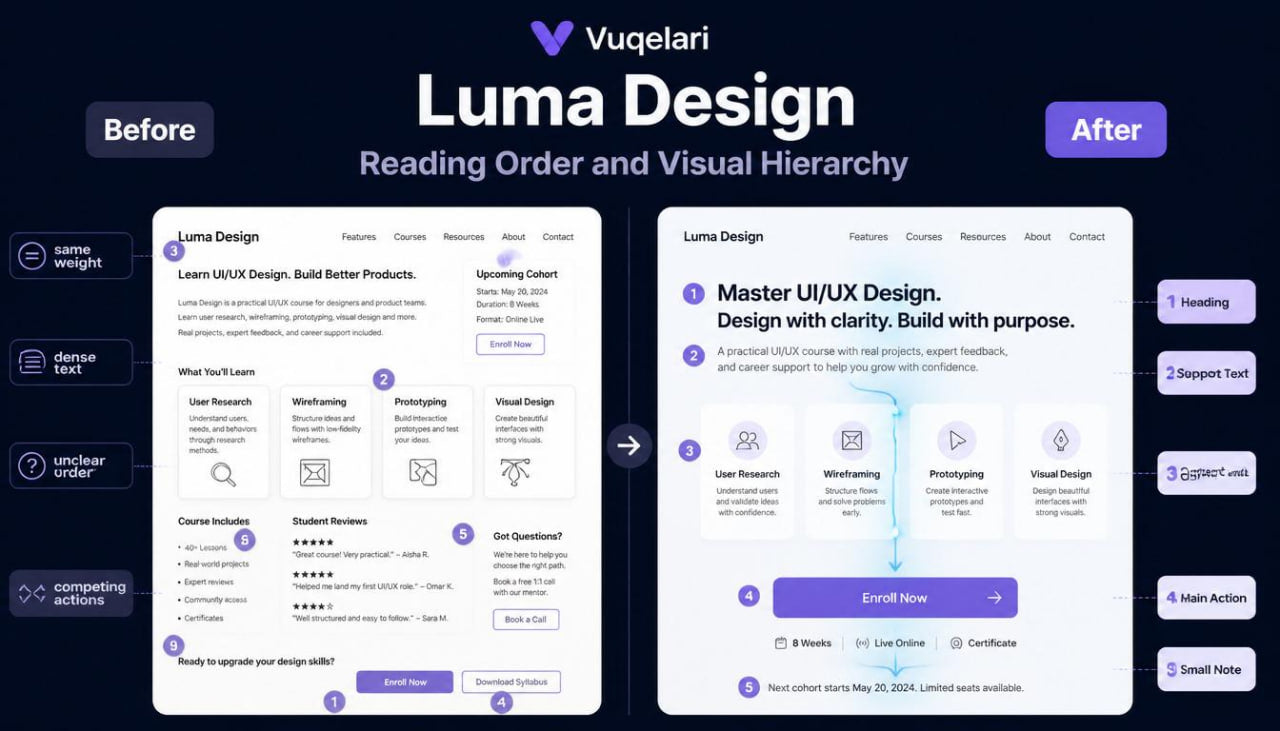
Many learners can build a basic interface outline, but they may struggle to make the screen feel visually readable. A layout can have the right sections, yet the page may still feel unclear if headings, text blocks, actions, and supporting details compete for attention. Learners may also find it difficult to decide which parts should appear stronger and which parts should remain quiet. When visual order is not planned, users may scan the page in the wrong direction or miss the main action. Luma Design was created to help learners study UI/UX design through visual reading, hierarchy, spacing, and screen emphasis.
- Solution
Luma Design teaches learners how to guide attention through interface structure rather than decorative effects. The course explains how headings, section spacing, contrast, grouping, text length, and action placement can create a clearer reading path. Learners study how visual weight works and how each screen element can support a specific role. The materials combine written modules, visual examples, review tasks, and practical checklists for self-paced study. This tier gives learners a thoughtful way to review UI/UX screens through visual order and layout clarity.
- What’s Inside
Luma Design includes a detailed set of UI/UX design materials focused on hierarchy, reading order, and visual structure. The first module introduces visual hierarchy as a practical design idea. Learners study how a screen can guide the eye from the main heading to supporting text, then to content groups and actions. The course explains that visual hierarchy is not only about making one element larger than another. It is about arranging page parts so the user can understand what matters first, what supports the message, and where to move next.
The second module focuses on heading systems. Learners explore how headings, subheadings, labels, and small notes create structure inside a layout. This section explains why headings should introduce content clearly, why subheadings should support the main idea, and why labels should stay close to the elements they describe. Learners review examples where heading order feels natural and examples where similar text sizes make the page harder to scan.
The next module studies visual weight. Learners examine how size, spacing, contrast, position, and grouping can make one element feel stronger than another. The course explains how visual weight can guide attention toward a main action, a key section, or an important message. It also explains that too much visual weight in too many places can make a page feel noisy. Learners practice identifying which parts of a sample screen should carry stronger attention and which parts should be quieter.
Luma Design also includes a module about spacing as structure. This section shows how spacing can separate topics, connect related elements, and create a calmer reading rhythm. Learners study how close spacing can show relationship, while wider spacing can show a new section or topic shift. The materials include examples of crowded layouts, uneven spacing, and balanced spacing patterns. Learners are asked to review sample layouts and explain how spacing changes the way the page is understood.
A separate module focuses on text density. Learners study how long blocks of text, short notes, section descriptions, list items, and labels affect the reading experience. The course explains how too much text in one area can slow down scanning, while too little context can leave the user unsure. This module helps learners decide when text should be shortened, grouped, divided, or moved into another section.
The course continues with a module about action visibility. Learners study how buttons, links, form actions, and choice areas can be placed so they follow the reading path. The materials explain how a main action should connect with the information that comes before it. Learners review examples where actions appear too early, too far from the related content, or with the same visual strength as secondary actions. This helps learners understand how visual order and action placement work together.
Luma Design includes a module about section contrast. Learners study how different parts of a page can be separated through spacing, borders, background areas, card shapes, text scale, and grouping. The goal is not to make the screen busy, but to show where one idea ends and another begins. The course explains how contrast can support clarity when used with care.
The practical exercises in this tier focus on visual review. One task asks learners to mark the reading order of a sample screen. Another task asks learners to reduce visual competition by choosing which elements should have stronger or quieter presentation. A third task focuses on revising a text-heavy section by dividing it into heading, short explanation, grouped points, and action area. Another exercise asks learners to plan a simple page with a visible hierarchy from top to bottom.
The tier includes several checklists. The hierarchy checklist asks: What should be noticed first? What supports the main idea? Are headings, labels, and actions easy to tell apart? The spacing checklist asks: Are related items close enough? Are different topics separated clearly? Is the page rhythm steady? The text checklist asks: Is the text divided into readable parts? Are labels placed near the related elements? Is any section carrying more text than it needs?
A glossary section is included with terms such as visual hierarchy, visual weight, reading order, text density, section contrast, spacing rhythm, heading system, action visibility, support text, and layout clarity. Each term is explained in simple UI/UX language and tied to practical screen review.
The recap section gathers the course ideas into one review method: identify the main message, shape the reading order, adjust visual weight, separate sections with spacing, review text density, and place actions where they fit the path.
- Who Is This For?
Luma Design is for learners who want to study UI/UX design through visual order and page readability. It is suitable for people who already understand basic layout, user flow, and screen mapping, but want to examine how attention moves through a page.
This tier may fit learners who ask questions such as: What should stand out first? Why does this screen feel crowded? How can sections feel more balanced? Where should the main action sit? How can text feel more readable inside a layout? The course gives learners a structured way to explore these questions through examples, exercises, and review notes.
Luma Design is also suitable for self-paced study. The materials do not depend on named programs or operating systems. The focus stays on UI/UX design thinking, hierarchy, spacing, reading order, and practical interface review.
- What You’ll Learn
- How to study visual hierarchy inside UI/UX layouts
- How headings, subheadings, labels, and notes shape reading order
- How visual weight guides attention across a screen
- How to decide which elements should appear stronger or quieter
- How spacing can separate topics and connect related elements
- How to review crowded layouts through spacing and grouping
- How text density affects scanning and page understanding
- How to divide text into headings, short explanations, and grouped points
- How section contrast can define different areas of a screen
- How buttons, links, and choice areas connect with visual flow
- How to review action visibility without making the page feel noisy
- How to mark the reading order of a sample interface
- How to reduce visual competition between elements
- How to plan a page with a clear top-to-bottom structure
- How to use practical checklists for hierarchy and spacing review
- How to connect visual order, content structure, and user movement
- 30-Day Refund Note
Vuqelari includes a 30-day refund window for orders that match the store policy conditions. Learners should review the course materials during this period and contact the support team if the tier does not match their study needs. Refund requests are handled through the store’s regular support process and may depend on order details, delivery status, and the policy information shown on the store page.
Self-paced learning overview
- 🗂️ Digital file available after purchase
- 📚 Long-term availability
- 🔒 Secure checkout
- 🗓️ Content updated in 2026
What format are the Vuqelari course materials provided in?
What format are the Vuqelari course materials provided in?
The Vuqelari course materials are prepared as digital learning resources for self-paced study. They include written modules, visual examples, practice tasks, checklists, and review sections.
Who are the courses made for?
Who are the courses made for?
The courses are made for learners who want to study UI/UX design through organized materials and practical exercises. Each tier has its own depth, from an introductory starting point to wider topic collections.
How do I study after placing an order?
How do I study after placing an order?
After placing an order, you receive the course materials through the store’s normal delivery process. You can study the modules at your own rhythm, return to earlier sections, and use the tasks for review.
Share